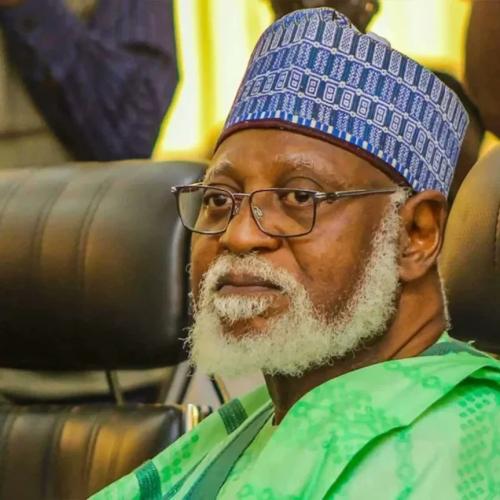

MKO Abiola, the acclaimed winner of the June 12, 1993 presidential election, collapsed during a meeting with US envoys in Abuja on July 7, 1998, and was not poisoned, according to former Head of State Gen. Abdulsalami Abubakar.
Abdulsalami made the revelation in his autobiography and earlier interviews. He described how Abiola suddenly became restless, started coughing, and began sweating profusely while interacting with the American delegation.
The delegation, led by Thomas Pickering with Susan Rice as a key member, had requested access to Abiola. Abdulsalami overruled the initial denial and instructed his Chief Security Officer, Abdulrasheed Aliyu, to arrange the meeting promptly.
“Aliyu called me. As soon as I picked, he said in a shaky voice that there was a problem. I asked: ‘What problem again?’ He said Abiola was dead. My head went blank,” Abdulsalami recounted.
Medical personnel and the US team rushed the ailing politician to the State House Clinic, where he passed away despite efforts to save him.
The former military leader emphasized his gratitude for the guidance that led him to facilitate the meeting. He noted that without the Americans' presence, explaining the circumstances would have been far more difficult.
An international autopsy team comprising pathologists from Nigeria, the United States, Britain, and Canada conducted a thorough examination at the family's request. They found no evidence of poisoning through toxicological analysis.
The report attributed Abiola's death to severe, long-standing heart disease, including significant narrowing of the coronary arteries and heart enlargement due to hypertension. These conditions had likely persisted for 10 to 14 years.
Dr. James G. Young, the Canadian coroner, publicly presented the findings on July 11, 1998. He stated that the circumstances, autopsy results, and eyewitness accounts did not align with poisoning patterns.
Abiola's death triggered immediate unrest, particularly in Lagos, fueled by widespread suspicions of foul play linked to the tea served during the meeting. These theories persisted despite official clarifications.
Abdulsalami dismissed poisoning allegations as fabrications. “I do not believe Abiola was poisoned,” he affirmed, expressing satisfaction with the autopsy outcome.
Recent discussions on X (formerly Twitter) reflect mixed reactions, with many users acknowledging the autopsy evidence while others question historical narratives around June 12. Some posts highlight the need for transparency on past events.

The incident remains a poignant chapter in Nigeria's democratic journey. Abdulsalami's account adds context to debates surrounding Abiola's legacy and the transition period after Gen. Sani Abacha's death.
Supporters and analysts continue to reflect on the broader implications for national healing and trust in institutions.





Comments
No comments yet. Be the first to comment!